All content © Yuffy Hon Piercing Lab Studio. Please credit and link back when sharing.
I get this question a lot from clients who are having a harder time healing. They start to worry and ask me. Is titanium bad for my skin. Why did you use titanium for the back. Why not use solid gold for everything. These are fair questions. So I want to explain what we actually know from medical and dental literature about titanium, what a real titanium allergy is, and what is more likely happening in most piercing situations.
Most of the research on titanium allergy comes from dental and medical implants. In those fields titanium has been used inside the body for decades and it has an excellent record. Dental studies report over 92 percent success and close to 95 to 99 percent survival at five years for implants. That is a very high success rate for something that lives in bone, in saliva and under constant chewing. The reason titanium works so well is that it forms a stable oxide layer on the surface. That layer makes it very resistant to corrosion and very biocompatible.
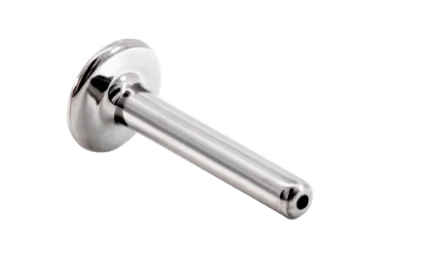
Because of that history, professional body piercers use implant grade titanium such as ASTM F136 or ISO 5832-3. It is light, nickel free and autoclavable. It is one of the safest materials we have for fresh piercings. That is why you see me use it so often.
So can someone still react to titanium. The answer is yes. But it is rare.
What titanium allergy actually is
A titanium allergy is a hypersensitivity reaction to titanium or to tiny amounts of material that are released from the surface. In medical literature this is described as uncommon. There are case reports but not large numbers. Most reactions that do exist look like delayed type reactions. This is an immune response where T cells react 24 to 72 hours later or sometimes a week later after exposure.
In dental patients the reaction can look like persistent redness around the implant, eczema on the face or neck, swelling around the implant with no infection, or bone loss that cannot be explained. In very rare cases symptoms stopped after the titanium was removed. That tells researchers that titanium allergy is real but it affects a very small group of people.
There is also a pattern. People who already react to other metals like nickel or palladium seem to have a higher chance of reacting to titanium. So a strong metal allergy history is a clue.
Why it is hard to diagnose
One of the biggest problems is that we do not have a perfect test. Patch testing can be used for metals but titanium does not always show up clearly on a skin test. Lymphocyte transformation tests and MELISA exist but they can give false positives or are not widely available. That means in real life people get diagnosed based on history, clinical signs, and ruling out other causes.
In piercing that makes it even trickier because so many non allergy issues can mimic an allergy. Friction from the bar being too long. Pressure from sleeping on the piercing. Overcleaning. Low quality aftercare products. Trauma from changing jewelry too early. All of those can create redness and bumps that people then blame on the metal.
Piercing and titanium
In body piercing we are not putting titanium inside bone. We are placing it through skin and sometimes cartilage. That is a much lighter exposure than a dental implant. If titanium can survive in bone for decades in saliva, it is very reasonable to use it in ear, nose or body piercings on the surface. This is why I tell clients that titanium has already been proven safe for much more demanding situations.
I still listen when someone tells me they have a known metal allergy. If the client has a history of bad reactions to multiple metals, or they already saw a dermatologist about metal contact dermatitis, I take that seriously. In those cases I can choose high karat gold fronts, threadless ends in gold, or in some situations use titanium posts with gold ends so the wearable part is gold and the safe post is still in place. Fourteen karat solid gold in the right alloy is also good for skin when it is nickel free and cadmium free and when it can be sterilized.
I also explain that sometimes it is not the titanium at all. It can be the surface finish, the presence of a coating, a non implant grade alloy, or even a jewelry piece that was called titanium but was not ASTM grade. This is why buying from verified manufacturers matters.
What to watch for in clients?
1.Here is what I look for if I suspect something stronger than simple irritation.
2. Persistent redness that does not improve even after we fix length, friction and aftercare.
3. Eczema like rash around the piercing or on nearby skin.
4. Itching plus dryness without obvious trauma.
5. Multiple piercings reacting at once with the same material.
6. History of reacting to dental work or implanted metal.
If I see those patterns I will tell the client to speak to their doctor or dermatologist. Piercers cannot diagnose allergies but we can recognize when healing is not following the usual curve.
Alternatives when titanium is a concern
In medicine, people who cannot tolerate titanium sometimes receive zirconia implants. Zirconia is ceramic, very biocompatible and has almost no reported allergy cases. In piercing we do not have zirconia posts, but we do have high quality gold and niobium, and sometimes we can reduce metal exposure by choosing jewelry styles with less surface contact.
If a client is very anxious about titanium I can offer solid gold in the right karat and alloy, or niobium, and I can keep the jewelry minimal while the piercing heals. I will still use sterile, polished, body safe pieces because material quality matters more than the metal name.
How I explain this to clients
I tell them titanium is not a random choice. It is used because it has decades of medical data behind it. Most irritation in piercings is not because the material is toxic. It is because the piercing was irritated mechanically or the jewelry was not sized or finished properly. So before we blame the metal we fix the obvious things. We downsize. We improve aftercare. We change to a verified implant grade piece. We stop flipping or rotating the jewelry. Only if the skin still refuses to calm down do we consider a rare sensitivity.
Thoughts
Titanium allergy exists but it is rare. Titanium remains one of the safest and most studied metals for use in the human body. In body piercing we benefit from that medical history. For the small number of clients who really do not tolerate titanium, we can work with alternative materials and we can partner with medical professionals. For the majority of clients, ASTM F136 titanium and 14K solid gold are excellent, safe choices.
Sources
Goutam, M. et al. (2014). Titanium allergy: A literature review. Indian J Dermatol., 59(6):630.
Sicilia, A. et al. (2008). Titanium allergy in dental implant patients: a clinical study. Int J Oral Maxillofac Implants, 23(3):502-505.
Komiya, A. et al. (2013). Allergic contact dermatitis caused by titanium screws and dental implants. J Prosthodont Res., 57(3):195-198.
Hosoki, M. et al. (2018). Clinical features of titanium allergy: A retrospective review of 115 cases. J Prosthodont Res., 62(4):426-431.
Comino-Garayoa, R. et al. (2020). Allergies to titanium dental implants: What do we really know about them. Biology (Basel), 9(11):404.
Siddiqi, A. et al. (2011). A Scoping Review of Zirconia as an Alternative to Titanium Implants. J Dent Res., 90(12):1413-1418.
Tella, S. et al. (2013). PEEK dental implants: a review of the literature. J Oral Implantol., 39(6):743-749.
Patil, P. et al. (2024). PEEK prospective prosthesis material: A narrative review. Int J Applied Dental Sciences., 10(1):124-128.
