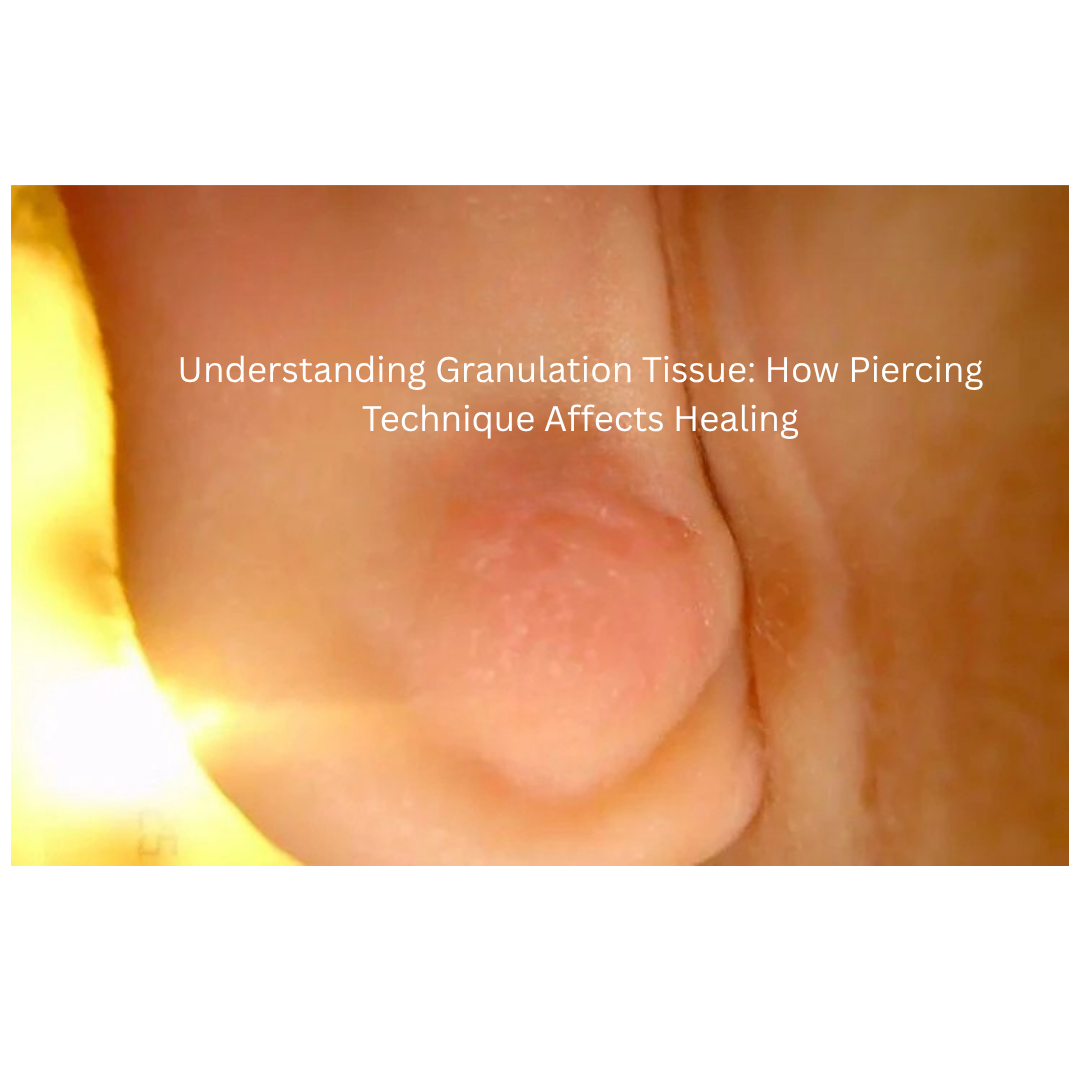
Understanding Granulation Tissue: How Piercing Technique Affects Healing
All content © Yuffy Hon Piercing Lab Studio. Please credit and link back when sharing.
What Is Granulation Tissue
Granulation tissue is a type of healing tissue that often appears red, moist, and uneven in texture. It may look like small, shiny bumps or have a “pebbled” surface. Because it is rich in blood vessels, it can bleed easily when touched.
After the skin is injured, the body forms granulation tissue to fill and repair the wound. It contains tiny new capillaries, fibroblasts, and inflammatory cells that help build collagen and promote new tissue growth. The bright red color comes from the dense network of new blood vessels, giving the tissue its distinctive appearance and soft, grainy texture.
In wound care, granulation tissue plays an important role in secondary healing — when a wound heals from the inside out instead of being closed by stitches. Inside a piercing, this process can sometimes go slightly off track, forming excess tissue that looks raised or irritated around the jewelry.
⚠️ Blood warning ahead — Scroll carefully!


How Granulation Tissue Forms
During the healing process, immune cells called macrophages clear away debris and release chemical signals that activate fibroblasts — the cells that produce collagen.
This, in turn, encourages angiogenesis, the formation of new blood vessels.
When healing proceeds smoothly, granulation tissue eventually matures into scar tissue and the surface re-epithelializes.
However, when a piercing is exposed to unnecessary trauma, pressure, or contamination, granulation tissue can become overactive.
This overgrowth can appear as a small red lump at the edge of a piercing channel, often mistaken for an infection or keloid.

Because hoop earrings have greater movement, they tend to rub against the piercing channel. The new tissue inside can become firm over time and gradually turn into scar tissue, which may make the area appear red, thick, or slow to heal.
Piercing Method and Its Impact on Healing
Many people assume there is no real difference between piercing guns and needles, but the two methods affect tissue in completely different ways.
Piercing Guns
Piercing guns use blunt force to push jewelry through the skin, creating a jagged tear rather than a clean incision.
This trauma increases the risk of:
-
Tissue irregularities that trap epithelial cells inside the dermis
-
Prolonged healing time due to uneven wound edges
-
Excessive pressure that can trigger granulation tissue or localized inflammation
Gun piercings are also difficult to sterilize, making them unsuitable for body piercing. In fact, many regions in the United States and Europe have banned piercing guns for use on cartilage, nostrils, navels, tongues, and other body parts. In New Hampshire, all non-sterile piercing tools are considered illegal for professional use.
Professional Needle Piercing
By contrast, a piercing needle is extremely sharp and glides smoothly through the tissue, creating a precise channel with minimal trauma.
This reduces the chance of epithelial cells being forced into deeper layers of skin, meaning fewer complications and a faster, cleaner healing process.
Choosing a needle-based, sterile piercing is not just a preference — it’s a scientifically supported decision that reduces the likelihood of granulation tissue formation and infection.
Material Choice Matters
Granulation tissue can also be aggravated by unsuitable jewelry materials.
Always ensure your jewelry is made from implant-grade titanium (ASTM F136) or other verified biocompatible metals.
Poor-quality alloys or coatings can irritate healing tissue and disrupt the repair process.
Piercing Education and Client Awareness
At Piercing Lab, we believe that true professionalism comes from education and responsibility.
Understanding how tissue responds to different piercing methods empowers both piercers and clients to make informed choices.
Healing is not just about time — it’s about biology, precision, and care.
Final Thought
Granulation tissue is a natural part of healing, not a sign of failure.
When piercings are performed correctly — with sterile technique, sharp tools, and appropriate materials — the body’s healing response works efficiently and predictably.
Science and artistry come together in every safe, well-executed piercing.
Reference:
Granulation tissue in Wound care: Identification, function, and management | WoundSource. (n.d.). https://www.woundsource.com/blog/getting-know-granulation-tissue-and-what-it-means-wound-care
皮膚科醫師王修含. (n.d.). 傷口癒合的肉芽組織(granulation tissue). https://www.skin168.net/2016/04/granulation-tissue.html
