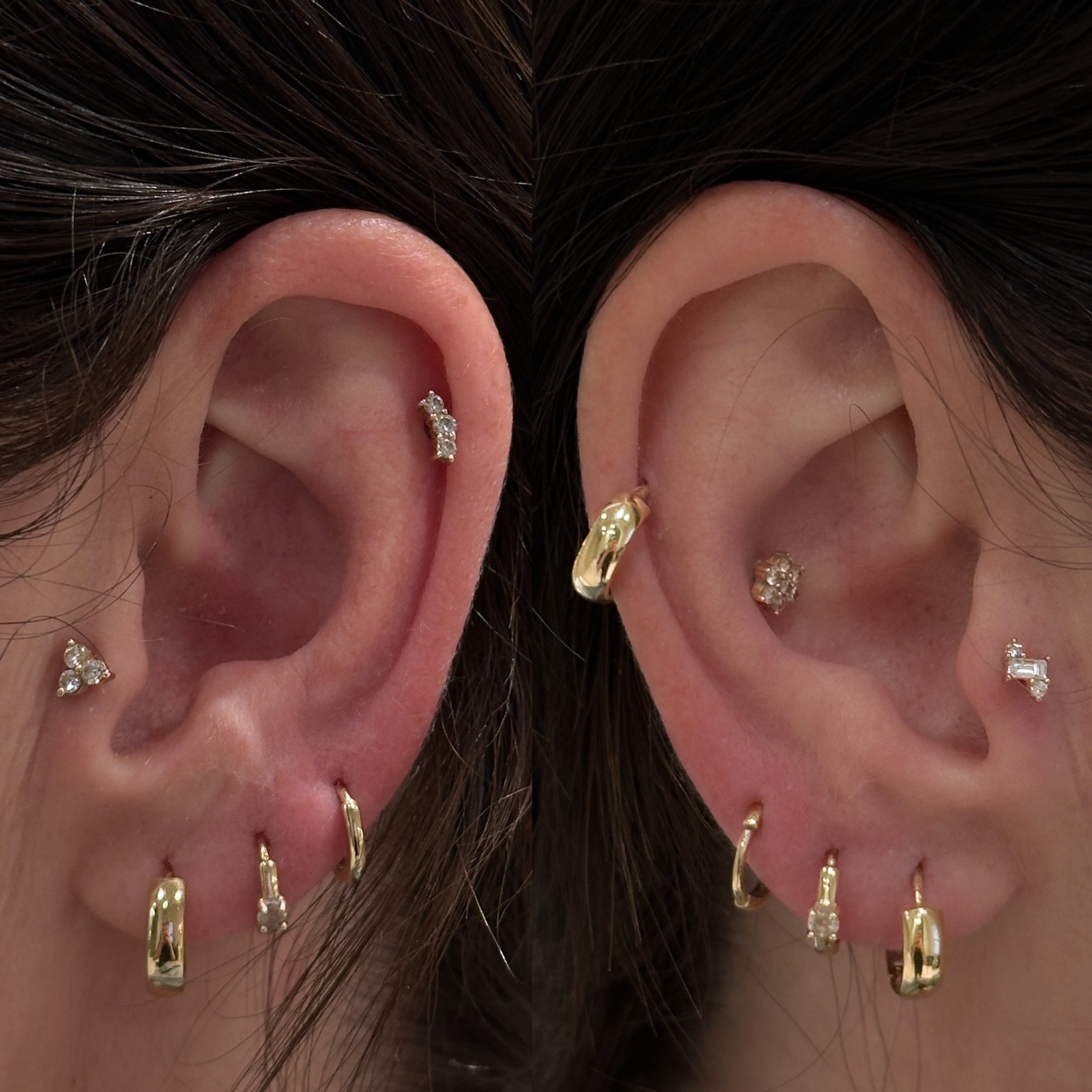
When Piercings Close: What to Do If You Can’t Get Your Jewelry Back In
All content © Yuffy Hon Piercing Lab Studio. Please credit and link back when sharing.
Yes — Any Piercing Can Close
Even well-healed piercings can close or tighten over time.
Whether it’s been a few months or even several years since you last wore jewelry, it’s still possible for the channel to shrink or seal.
Many clients are surprised when they try to reinsert jewelry and find resistance but this doesn’t always mean the piercing is “gone.” Sometimes, it just needs a little professional help to reopen safely.
Common Situations
Channel Narrowing
Often, what feels like a “closed” piercing is simply a partially tightened channel.
The entrance may have closed slightly while the inner tissue remains intact. In these cases, it’s usually possible for a professional piercer to gently reopen the pathway.
One client I worked with hadn’t worn earrings for over 30 years, and we were still able to safely reopen her original piercings — no re-piercing needed.
Professional Reopening: The Gentle Approach
At a professional studio, your piercer can use precision tools to gradually stretch the tissue back to its original size.
This is done slowly and carefully, minimizing trauma and usually without any bleeding.
To make the process smoother, we apply a small amount of sterile lubricant or ointment, allowing the jewelry to glide in comfortably.
You may feel some tightness for the first few days, but it’s far easier and gentler than going through a full healing cycle again.
At Piercing Lab, reopening services are typically complimentary and only pay for the jewelry itself.
When Re-Piercing Is the Better Option
If reopening doesn’t work, or if the tissue has fully sealed, re-piercing is still a safe and effective choice.
Certain areas, like earlobes, cartilage, navels, or septums, sometimes maintain a visible indentation even after closing, which helps guide the new piercing.
However, if your previous piercing was misaligned or poorly placed, re-piercing can also be an opportunity to correct the angle and improve long-term comfort and appearance.
Case Example
A client once came to us with a previously inflamed piercing from another studio.
After switching to implant-grade titanium jewelry and following proper aftercare, the piercing healed beautifully.
Later, we decided to re-pierce to correct the angle and demonstrating how thoughtful placement and professional guidance can make all the difference.


Key Takeaway
A “closed” piercing isn’t always the end of the story.
Professional piercers can often help you reopen the channel safely without starting over.
If re-piercing is needed, it’s also a chance to do it better , with proper placement, sterile technique, and high quality materials.
Your piercer’s goal is always the same: to protect your skin, your comfort, and your confidence.
Explore More
🔹 Want to learn more about piercing care and healing? Visit our [Piercing Blog].
🔹 Ready for a professional consultation? [Book your appointment here].
For additional reference, the Association of Professional Piercers (APP) offers detailed aftercare and material guidelines for clients and studios worldwide.
Our Commitment
At Piercing Lab, every article we share is based on scientific knowledge and real professional experience.
We believe in clear education, responsible care, and helping clients make informed choices about their piercings.
